
The Time-Traveler's Guide to Mental Survival: The Ancient Philosophy Behind Modern Therapy
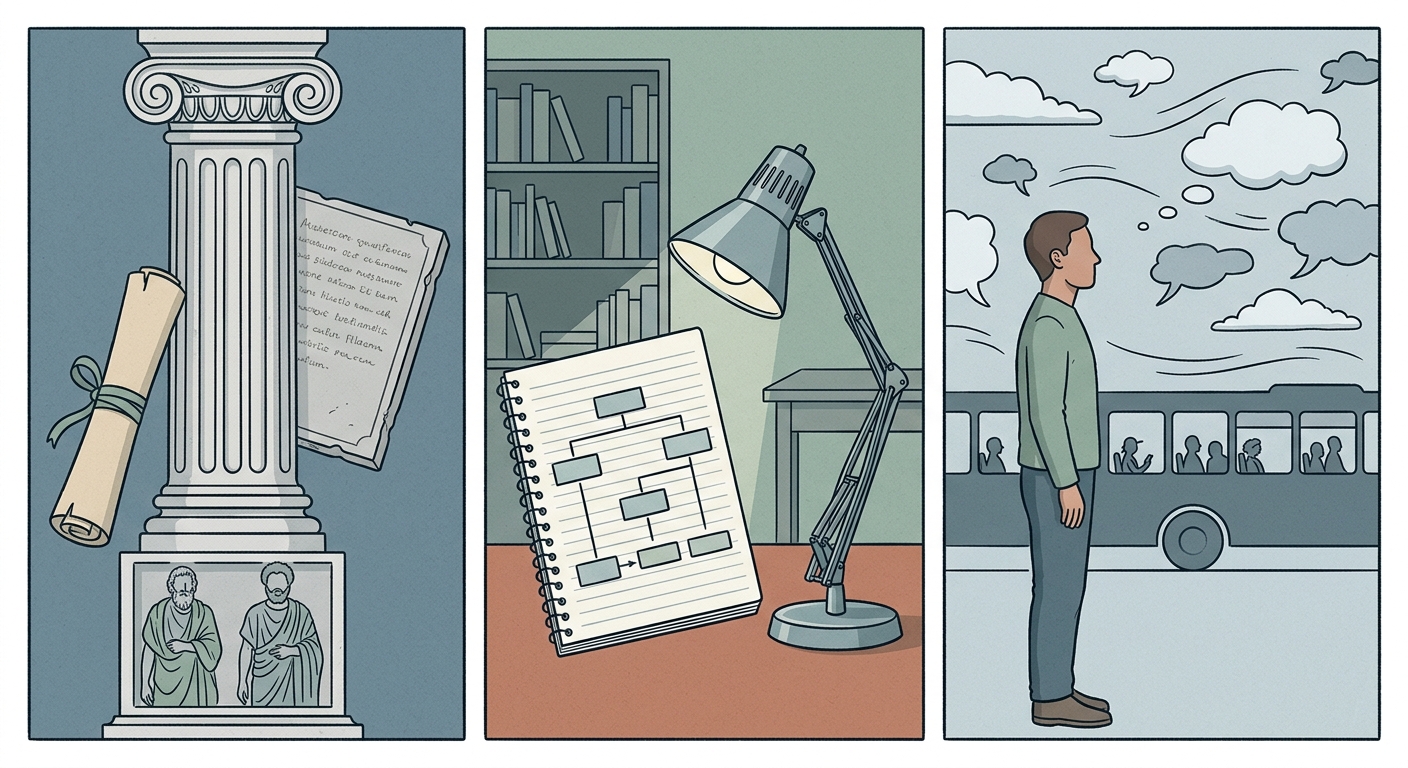
Cognitive behavioral therapy is among the most extensively studied families of psychological treatment. A 2012 review identified 269 distinct meta-analyses of CBT outcomes (Hofmann et al., 2012), and a more recent synthesis confirmed its effectiveness for depression across hundreds of trials (Cuijpers et al., 2023). Less often noted alongside that evidence: several ideas central to CBT have recognizable precedents in ancient Stoic psychology. The three modules below trace that lineage from the Stoic philosophers of ancient Greece and Rome through the clinical laboratories that built CBT and ACT, and into tools you can use today.
This article is educational and historical. It is not medical advice, diagnosis, or a substitute for professional care. If you are struggling, please consult a qualified mental-health professional.
Before the history, a diagnostic: for the next five seconds, try to silence your mind completely. Do not, under any circumstances, think about a white bear.
The image arrives anyway. This is Ironic Process Theory, demonstrated empirically by Daniel Wegner: deliberate suppression of an unwanted thought causes the brain's monitoring system to hyper-focus on precisely that thought, making it more intrusive (Wegner et al., 1987; Wenzlaff & Wegner, 2000). Telling yourself to "stop worrying" risks triggering the same paradox. You cannot delete a thought by ordering it gone. The sections below are about what you can do instead.
Module 1: The Stoa: Ancient Roots of Cognitive Resilience
Chrysippus and the Architecture of Emotion
The Stoic school was founded in Athens around 300 BCE. Its most psychologically ambitious heir, Chrysippus of Soli (c. 279-206 BCE), produced more than 700 works on logic, physics, and ethics, virtually all lost, reconstructed through later sources including Cicero, Galen, and Diogenes Laertius (Reydams-Schils, 2002).
Chrysippus's central contribution was a radical position on emotion. Against the Platonic tradition, which divided the soul into rational and irrational parts in perpetual conflict, Chrysippus treated the adult human soul as a unified rational faculty — a position sometimes called psychological monism (Knuuttila, 2016; Shogry, 2021). Passions were not eruptions from a separate irrational compartment. An emotional passion (what the Greeks called pathe) involved an evaluative judgment about what is valuable, or an excessive impulse, arising within that unified mind (Knuuttila, 2016; Shogry, 2021). Anxiety, on this view, is not produced by events alone; interpretation is one part of the response. If appraisal helps shape emotion, then learning to examine the appraisal can change the emotional response. This does not make Chrysippus a proto-CBT therapist, but it is a striking conceptual precedent for the cognitive-appraisal approaches that CBT would later formalize (Cavanna et al., 2023).
Epictetus, a Greek-speaking former slave from Hierapolis who taught in Rome until philosophers were expelled under Domitian, after which he founded a school in Nicopolis, compressed the framework into a single sentence in the Enchiridion: "Men are disturbed not by things, but by the view which they take of things." Aaron Beck would say almost the same thing two millennia later, in clinical rather than philosophical language.
The Dichotomy of Control
Epictetus opens the Enchiridion with the tool the Stoics considered foundational: the Dichotomy of Control. Some things are "up to us," meaning our judgments, desires, aversions, and intentions. Some things are not: our bodies, reputations, property, and other people's behavior. Modern life routinely obscures this line. You can spend enormous cognitive energy on your social media metrics, your manager's mood, or the traffic on your commute, none of which you control, while leaving comparatively unexamined the domain in which you have the greatest influence: the judgments and actions you practice next.
Practicing the Dichotomy of Control is a sorting exercise. Before reacting to a stressor, you pause and ask: is this within my sphere of will, or outside it? When outside, the Stoic move is to redirect that energy toward what you can shape. Modern research likewise associates perceived control with psychological adjustment and resilience under stress; though perceived control is not identical to the Stoic line between what is and is not "up to us," and an internal locus of control can itself become maladaptive when people shoulder responsibility for outcomes they could never have controlled.
Premeditatio Malorum: Inoculation Through Rehearsal
The Stoics also practiced premeditatio malorum, deliberate visualization of potential setbacks. Seneca counseled in his letters the rehearsal of difficulties: a difficult conversation, a project that falls through, a moment of public embarrassment. The aim was inoculation. When the setback arrived in reality, it met a mind that had already moved through the emotional territory once, under calm conditions.
Modern stress-inoculation training, used in military, surgical, and high-performance athletic contexts, follows the same logic: mentally rehearse the hard scenario at low stakes so that your first exposure to the real thing is not also your first exposure to managing your reaction to it.
The Pause and Its Disputed Ownership
A famous passage attributed to Viktor Frankl runs: "Between stimulus and response, there is a space. In that space lies our freedom and our power to choose our response. In our response lies our growth and our happiness." It does not appear in any of Frankl's published works.
The misattribution traces to Stephen Covey, who recounted in his foreword to Alex Pattakos's Prisoners of Our Thoughts (2010) encountering those three lines in a university library during a writing sabbatical in Hawaii. Covey recorded that he never noted the author or title and was never able to give proper attribution, yet because he repeatedly cited the lines as a perfect expression of Frankl's teachings, the words fused to Frankl's name in the public imagination. A close precursor appears in the work of Rollo May, though the author of the familiar three-sentence version remains uncertain.
May's related formulation: "Human freedom involves our capacity to pause between stimulus and response and, in that pause, to choose the one response toward which we wish to throw our weight" (Freedom and Destiny, 1981).
Frankl expressed the same idea in his own words, drawn from his experience in Nazi concentration camps: "Everything can be taken from a man but one thing: the last of the human freedoms, to choose one's attitude in any given set of circumstances, to choose one's own way" (Man's Search for Meaning, 1946).
The Stoic ancestor of both formulations is synkatathesis, the act of assent, the choice to agree or disagree with an incoming impression before being moved by it (Shogry, 2018). The "pause" May and Frankl describe is what the Stoics had been practicing for centuries. The lineage matters as a teachable point about how ideas travel and accrue false pedigrees, and why checking primary sources matters.
Module 2: The Laboratory: CBT and the Science of Thinking
Beck's Anomalous Finding
In the late 1950s and early 1960s, Aaron Beck was a psychiatrist at the University of Pennsylvania attempting to validate the prevailing psychoanalytic theory that depression was produced by hostility turned inward. His instrument was dreams. Freudian theory called them "the Royal Road to the Unconscious." He expected to find them saturated with repressed hostility. He found the opposite: depressed patients' dreams contained less hostility than those of non-depressed patients, centering instead on themes of rejection, loss, and personal inadequacy. Concurrently, Beck noticed patients running a constant internal commentary, rapid, spontaneous, consistently negative interpretations of events, largely unexamined (Beck, 2006).
Beck called these "automatic thoughts." They were not repressed; they were just fast. A colleague passes you in the hallway without saying hello. The automatic thought arrives before deliberation: She's angry with me. I must have done something wrong. You do not choose that thought; it arrives pre-formed. Beck's insight was that these thoughts can be tested as hypotheses. Teaching patients to surface them, weigh the evidence, and reach more accurate conclusions produced measurable relief from depression (Hofmann et al., 2012; Cavanna et al., 2023).
Albert Ellis, developing Rational Emotive Behavior Therapy along parallel lines, was explicit about the lineage: he named Epictetus and the Enchiridion as a direct precursor and described the philosophical connection from Stoic cognitive appraisal to his ABC Model (Ellis, 1962; Cavanna et al., 2023). Ellis's ABC framework maps almost directly onto Chrysippus's sequence: A (Activating Event) is the external stimulus; B (Beliefs, the cognitive appraisal) corresponds to Chrysippus's phantasia plus synkatathesis; C (Emotional Consequences) is the resulting pathe.
Common Cognitive Distortions
CBT identifies patterns of distorted appraisal that reliably produce emotional suffering. Learning to name them is the first step toward catching them in real time:
Catastrophizing: treating a plausible bad outcome as a certain catastrophic one. The project is late, therefore your career is over. CBT asks: what is the realistic probability of the worst outcome?
All-or-nothing thinking: evaluating situations in binary terms when most outcomes are continuous. The presentation was not perfect, therefore it was a failure. CBT asks: on a spectrum from 0 to 100, where does this land?
Personalization: assuming you are the cause of events with multiple plausible explanations. CBT asks: what other factors might have contributed?
Mind-reading: assuming you know what others are thinking, usually negatively, without evidence. CBT asks: what evidence do you have, and what alternative interpretations are equally consistent with the observable facts?
The Thought Record
The Thought Record is CBT's central practical tool: cross-examining an automatic thought the way a competent lawyer cross-examines an unreliable witness. The structure:
- Situation: what happened, objectively, stripped of interpretation.
- Automatic thought: write it verbatim.
- Emotion and intensity: what did you feel, 0-100.
- Evidence for the thought: what supports it.
- Evidence against: what contradicts it or makes an alternative equally plausible.
- Balanced response: a more accurate, less distorted framing.
- Outcome: emotion intensity now, 0-100.
The power of the Thought Record is not that it produces relentless positivity. The balanced response is often still negative: the project really is late, and there will be consequences. But "the project is late and I need to have a difficult conversation with my manager" is a problem you can work on. "My career is over" is a catastrophe you can only survive or not. The Thought Record moves you from the second framing to the first.
CBT adopted a method conventionally called Socratic questioning: asking progressive, open questions that help a person examine the assumptions underlying their automatic thoughts, rather than confronting those assumptions directly (Beck, 1979). Direct confrontation can trigger defensiveness. Questions, such as "What would you say to a friend who described the situation this way?" invite the person to use their own capacity for reason. This closely resembles what Chrysippus described when he wrote about synkatathesis: pausing before granting assent to an impression, inspecting it, and choosing whether to endorse it. The therapeutic technique closely resembles the philosophical practice.
Module 3: ACT and the Limits of Argumentation
When Fixing Thoughts Amplifies Them
Cognitive restructuring, identify a distorted thought, examine the evidence, replace it with a more accurate one, works well when a thought contains testable distortions and examining the evidence opens new possibilities. But it is one technique within CBT, not the whole of it; contemporary CBT also includes exposure, behavioral activation, behavioral experiments, and acceptance-oriented methods. And not every difficult thought becomes more workable through repeated analysis. In some situations, continued evaluation slides into rumination or into another struggle to control internal experience. This is the white-bear problem again, since arguing against a thought requires you to hold it vividly in mind.
Acceptance and Commitment Therapy, developed by Steven Hayes and colleagues in the 1980s and 1990s, approached that situation from a different angle, asking not whether a thought is true or false but whether it can be present without dictating what happens next (Hayes, Strosahl, & Wilson, 2012). ACT is grounded in functional contextualism, which asks how a psychological act functions in a particular context; in practice, that shifts attention from debating every thought's literal truth to examining what happens when you organize your behavior around it (Hayes, Barnes-Holmes, & Wilson, 2012). The framework placed ACT in the "third wave" of cognitive therapies (Cavanna et al., 2023).
Cognitive Defusion: Watching Thoughts Rather Than Wrestling Them
ACT's central technique is cognitive defusion: learning to observe thoughts as mental events rather than literal reality. A thought is a sequence of words your mind produces. The thought refers to something; it is not the thing it refers to. "I am a failure" is a sentence. You can notice that sentence, watch it arise, and decline to act on it, without arguing that it is false.
ACT defusion exercises include prefixing every difficult thought with "I am having the thought that..." so "I am a failure" becomes "I am having the thought that I am a failure." The slight distance created by that prefix interrupts the automatic fusion between thought and self. Another approach: give the internal monologue a descriptive name ("the anxiety machine," "the disaster narrator") and address it as a separate entity. The practice is a deliberate use of language to de-literalize the commentary; it is not dissociation.
The Stoic ancestor of defusion is Chrysippus's warning against hasty assent: an expert thinker treats non-evident impressions with deliberate caution, observing them as mental events rather than accepting them as absolute reality (Shogry, 2018). ACT's treatment of a thought as "just a thought, not the truth" works in the same register (Cavanna et al., 2023).
Values as Navigation
If CBT asks "Is this thought accurate?", ACT asks "What do you want your life to be about, and are your actions moving you toward that?" Values in ACT function as directions you orient toward, rather than destinations you reach. Goals can be achieved or failed; values are orientations. "I value intellectual honesty" is a direction. "I want to finish this course" is a goal.
The point of identifying values is to anchor committed action in something more durable than mood or motivation. On the days when anxiety is high and the white bear is very present, values give you a reason to act that does not depend on first resolving the internal weather. You can be anxious and still do the thing that matters to you. You do not need the thoughts to quiet down first.
This is the practical content of the stimulus-response gap that Rollo May and Frankl described. The pause is not empty; it is the space where you consult your values and choose an action aligned with them.
Driving Past the Passengers
A central ACT image: imagine you are driving a bus, and your difficult thoughts and feelings are passengers. Some of them are loud. Some keep moving to the front and trying to grab the wheel. ACT's position is that you do not need to eject the passengers, reason with them, or prove them wrong. You keep driving toward your destination. The passengers can shout; you can acknowledge them and keep driving. You are the driver. They are passengers.
This gives particular emphasis to something less prominent in simplified accounts of Stoic reason and cognitive restructuring: you may not be able to eliminate difficult thoughts, and you may not always be able to reframe them in the moment. But you can decide what you do next regardless of their presence. Committed action is possible even in the presence of discomfort.
Venting Does Not Discharge Emotion
One persistent myth in popular psychology holds that negative feelings build up like pressure in a pipe, and that "letting off steam," meaning venting, punching a pillow, rehearsing grievances at length, releases that pressure. The simple hydraulic model of anger, in which aggressive venting drains a fixed reservoir of emotion, is not supported by the evidence. Research by Bushman (2002) found that venting anger by hitting a punching bag while thinking about the provocateur increases, rather than decreases, aggressive feelings and behavior. Venting rehearses and intensifies the emotional state rather than discharging it.
ACT's defusion and mindful observation approach works in the opposite direction: observe a feeling as a passing mental event and let it move through without adding fuel. Non-engagement is a distinct skill from active suppression. Wegner's ironic-process research makes clear that active suppression rebounds (Wegner et al., 1987; Wenzlaff & Wegner, 2000); defusion aims at a different process: letting the thought be present without either suppressing it or repeatedly elaborating it.
Metacognition: The Through-Line Across All Three Modules
The skill connecting Stoic philosophy, CBT, and ACT is metacognition: the ability to observe your own thinking process, not just the content of individual thoughts. Chrysippus described it when he distinguished the expert thinker who inspects impressions before granting assent from the novice who takes them at face value (Shogry, 2018). Beck's Thought Record trains it when it asks you to step back and examine an automatic thought as evidence rather than fact. ACT's defusion exercises develop it when they teach you to watch thoughts arise without fusing with them.
Modern metacognitive therapy, developed by Adrian Wells from the Self-Regulatory Executive Function model he built with Gerald Matthews (Wells & Matthews, 1994; Capobianco & Nordahl, 2023), formalizes this observation. Wells distinguishes between object-level cognition (the content of thoughts) and metacognition: beliefs about thoughts, such as "I must control my worry" or "Ruminating helps me solve problems." In Wells's account, anxiety and depression are maintained by a Cognitive Attentional Syndrome: perseverative worry, rumination, threat monitoring, plus counterproductive coping including thought suppression, driven by metacognitive beliefs that frame worry as either uncontrollable or necessary. Addressing the meta-level can be more efficient than addressing content-level thoughts one by one. A systematic review found large effects for metacognitive therapy relative to waitlist controls, and smaller but favorable effects relative to other cognitive-behavioral treatments (Andersson et al., 2025).
For practical self-application: whenever you notice a spiral, the same thought returning, the same anxiety looping, instead of asking "Is this thought true?" ask "What am I doing with this thought right now? Is engaging with it moving me forward, or keeping me stuck?" That second question is metacognitive. It puts you in the position of the observer rather than the observed. It is what Chrysippus meant by deliberate caution before assent, what Beck meant by stepping back to examine an automatic thought, and what Hayes meant by defusing from the content and asking what matters instead.
The Three Instruments
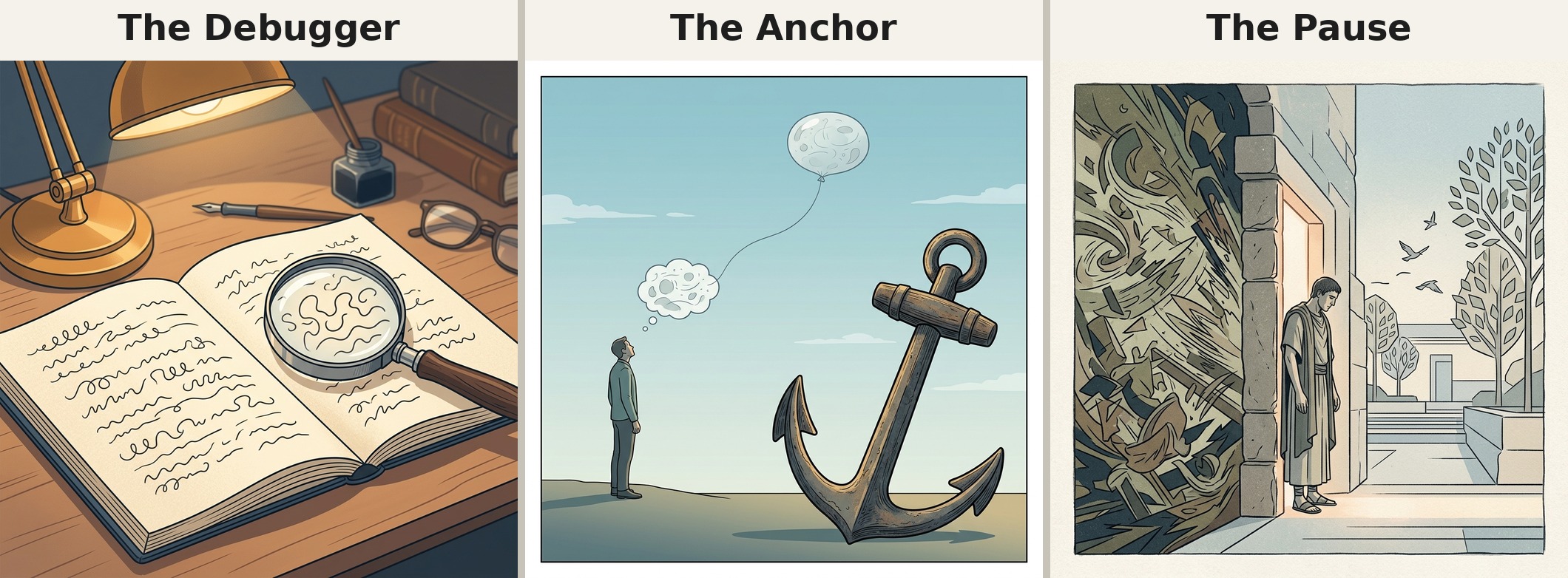
You now have the lineage. Chrysippus built the architecture: unified mind, cognitive appraisals, the pause before assent. Epictetus packaged it for daily life: control your judgments, redirect your energy, premeditate adversity. Beck and Ellis rediscovered the mechanism empirically and gave it clinical tools: automatic thoughts, the Thought Record, Socratic questioning. Hayes extended the toolkit: defusion, values, committed action in the presence of discomfort.
Three instruments follow from that history:
The Debugger (CBT): When you notice distorted automatic thoughts, examine the evidence. Run the Thought Record. Cross-examine catastrophizing with the same rigor you would bring to a business case. Thoughts work as hypotheses to test.
The Anchor (ACT): When engaging with a thought amplifies it, defuse it instead. Observe it as a sentence your mind produced, name it, and let it pass without acting on or against it. Identify what you value, and take the next action toward that value regardless of the internal weather.
The Pause (Stoicism): In the gap between stimulus and response, you are not powerless. The Stoics spent centuries documenting what you can do in that gap: sort what is within your control from what is not, premeditate adversity, consult your values, choose your response. That gap is where your freedom lives.
The passengers on the bus will not stop talking. You do not need them to. You just need to keep driving.
References
Andersson, E., Aspvall, K., Schettini, G., Kraepelien, M., Särnholm, J., Wergeland, G. J., & Öst, L.-G. (2025). Efficacy of metacognitive interventions for psychiatric disorders: A systematic review and meta-analysis. Cognitive Behaviour Therapy, 54(2), 276-302.
Beck, A. T. (1979). Cognitive therapy of depression. Guilford Press.
Beck, A. T. (2006). How an anomalous finding led to a new system of psychotherapy. Nature Medicine, 12(10), xiii-xiv.
Bushman, B. J. (2002). Does venting anger feed or extinguish the flame? Catharsis, rumination, distraction, anger, and aggressive responding. Personality and Social Psychology Bulletin, 28(6), 724-731.
Capobianco, L., & Nordahl, H. (2023). A brief history of metacognitive therapy: From cognitive science to clinical practice. Cognitive and Behavioral Practice, 30(1), 45-54.
Cavanna, A. E., Purpura, G., Riva, A., Nacinovich, R., & Seri, S. (2023). The Western origins of mindfulness therapy in ancient Rome. Neurological Sciences, 44(6), 1861-1869.
Cuijpers, P., Miguel, C., Harrer, M., Plessen, C. Y., Ciharova, M., Ebert, D., & Karyotaki, E. (2023). Cognitive behavior therapy vs. control conditions, other psychotherapies, pharmacotherapies and combined treatment for depression. World Psychiatry, 22(1), 105-115.
Ellis, A. (1962). Reason and emotion in psychotherapy. Lyle Stuart.
Hayes, S. C., Barnes-Holmes, D., & Wilson, K. G. (2012). Contextual behavioral science: Creating a science more adequate to the challenge of the human condition. Journal of Contextual Behavioral Science, 1(1-2), 1-16.
Hayes, S. C., Strosahl, K. D., & Wilson, K. G. (2012). Acceptance and commitment therapy: The process and practice of mindful change (2nd ed.). Guilford Press.
Hofmann, S. G., Asnaani, A., Vonk, I. J. J., Sawyer, A. T., & Fang, A. (2012). The efficacy of cognitive behavioral therapy: A review of meta-analyses. Cognitive Therapy and Research, 36(5), 427-440.
Knuuttila, S. (2016). On the history of the tables in taxonomy of emotions. L'Atelier du CRH, 16.
May, R. (1981). Freedom and destiny. Norton.
Pattakos, A. (2010). Prisoners of our thoughts: Viktor Frankl's principles for discovering meaning in life and work (2nd ed., with foreword by S. R. Covey). Berrett-Koehler.
Reydams-Schils, G. J. (2002). Emotion and peace of mind (review). Journal of the History of Philosophy, 40(2), 255-256.
Shogry, S. (2018). Creating a mind fit for truth: The role of expertise in the Stoic account of the kataleptic impression. Ancient Philosophy, 38(2), 357-381.
Shogry, S. (2021). Psychological disease and action-guiding impressions in early Stoicism. British Journal for the History of Philosophy, 29(5), 784-805.
Wegner, D. M., Schneider, D. J., Carter, S. R., & White, T. L. (1987). Paradoxical effects of thought suppression. Journal of Personality and Social Psychology, 53(1), 5-13.
Wells, A., & Matthews, G. (1994). Attention and emotion: A clinical perspective. Erlbaum.
Wenzlaff, R. M., & Wegner, D. M. (2000). Thought suppression. Annual Review of Psychology, 51(1), 59-91.