
Metacognition for Self-Directed Learners: How to Stop Fooling Yourself About What You Know
You can spend two hours with a book and still be wrong about what you know.
That is not a character flaw. It is a normal learning problem. When material feels familiar, your brain often treats that feeling as evidence of mastery. When a video explanation sounds clear, you may mistake the instructor's fluency for your own understanding. When highlighted pages look busy, you may feel productive even if you cannot explain the ideas without looking.
Metacognition is the skill that interrupts that mistake. It means monitoring your own thinking, judging what you know, and choosing a better next study move (Flavell, 1979). For self-directed learners, it is the difference between collecting inputs and running a learning system.
If you study without a teacher, syllabus, tutor, or exam schedule, metacognition becomes especially important. You have to decide what deserves review, when to test yourself, whether an explanation is good enough, and when to move on. Those judgments are often noisy, but you can make them more accurate with simple routines.
The core problem: fluency feels like learning
The most common metacognitive trap is fluency. If something is easy to read, easy to recognize, or easy to follow, you may judge that you know it. But recognition is not the same as recall. In experiments on learning judgments, people often give high confidence ratings to material that feels fluent, even when that fluency does not produce durable memory later (Koriat, 1997; Bjork, 1999).
You can test the difference in under a minute. Read a short paragraph, close the page, and explain the idea aloud without using the author's words. If the explanation collapses, you did not know it as well as it felt. You recognized it while it was in front of you.
That gap matters because many popular study behaviors increase fluency without forcing recall. Re-reading can make a passage feel smoother. Highlighting can make the page look organized. Watching another tutorial can make a hard concept feel temporarily clear. Reviews of study techniques consistently find that practice testing and distributed practice have stronger support than re-reading and highlighting for long-term learning (Dunlosky et al., 2013).
The lesson is not that reading is useless. You need exposure before you can retrieve. The lesson is that input needs a checkpoint. After you read, ask: can I produce the idea, solve the problem, or make the distinction without the source?
Metacognition is a loop, not a personality trait
Good learners are not simply more confident or less confident. They run a better loop.
- Predict. Before studying, state what you think will be hard.
- Attempt. Try to recall, solve, explain, or apply the material.
- Check. Compare your answer against a source, answer key, rubric, or worked example.
- Adjust. Decide what to review, space, rewrite, or practice next.
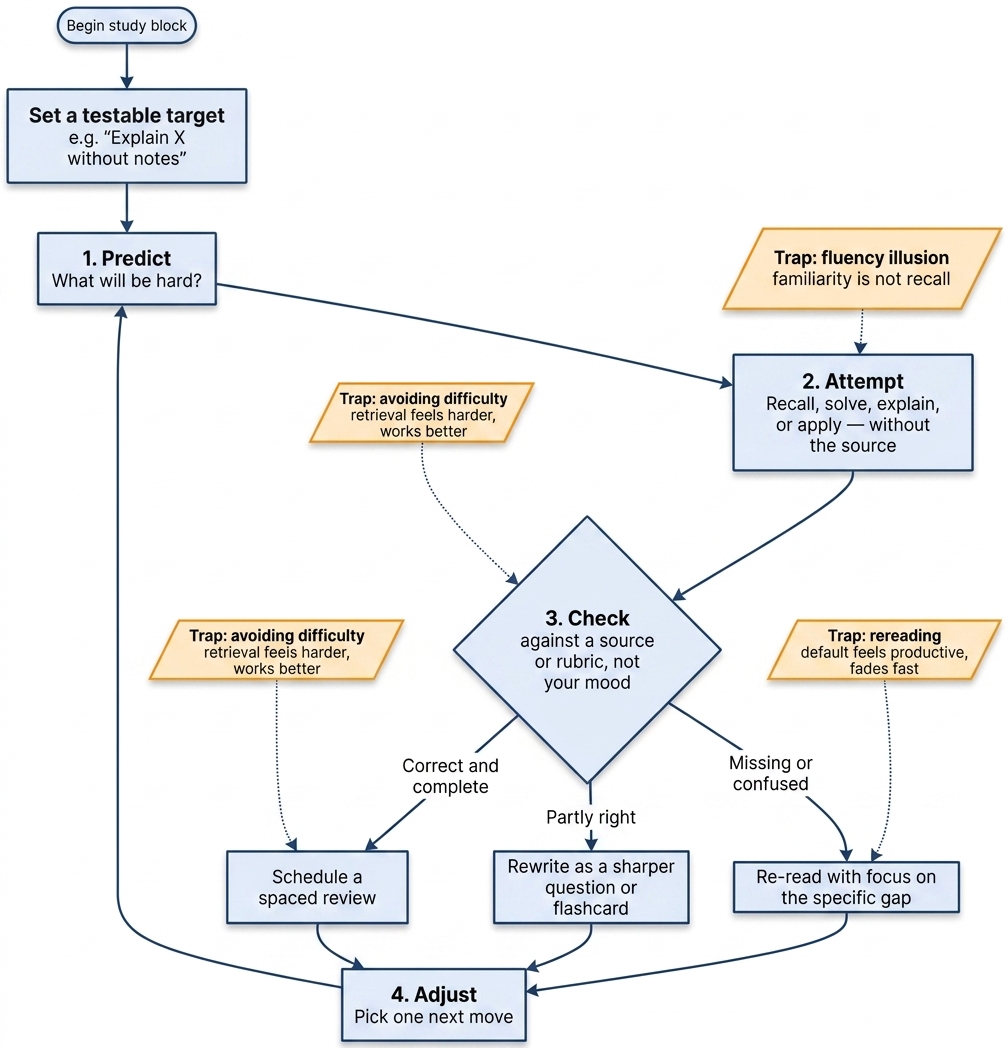
This loop matters because your first judgment is often biased. Learners can be overconfident after easy exposure and underconfident after effortful but productive practice (Koriat, 1997; Bjork & Bjork, 2011). Retrieval practice can feel harder than re-reading, but the difficulty is often useful because it exposes what you can actually bring to mind (Roediger & Karpicke, 2006).
That is why metacognition pairs so well with active recall. Active recall gives you evidence. Metacognition tells you what to do with that evidence.
If you want the practical memory system behind this article, start with The Memory Toolkit. It covers retrieval practice, spacing, interleaving, elaboration, and mnemonics in a short evidence-led format.
A simple metacognitive study session
Use this structure for a book chapter, online course lesson, paper, or professional skill.
1. Set a target before you start
Do not begin with "study chapter 4." That is too vague to check. Write a target you can test.
Better targets look like this:
- "Explain the difference between recognition and recall."
- "Solve three practice problems without looking at the worked example."
- "List the causes of this historical event and rank them by importance."
- "Use this framework to critique a real business decision."
Specific targets improve monitoring because they give you a standard for success. Self-regulated learning research treats goal-setting, monitoring, and strategy adjustment as linked parts of effective independent learning (Zimmerman, 2002).
2. Make a prediction
Before you study, write a one-sentence prediction:
I think the hardest part will be ______ because ______.
This turns a vague feeling into a testable judgment. After the session, you can ask whether the prediction was right. Over time, you learn your own patterns. Maybe equations look scary but become manageable after examples. Maybe conceptual distinctions feel easy until you must explain them. That pattern is useful data.
3. Study briefly, then close the source
Read, watch, or listen in a short block. Then close the source and attempt retrieval. Keep the delay short enough that you are testing the session's learning, not punishing yourself for forgetting everything.
Try one of these prompts:
- "What were the three most important ideas?"
- "What problem does this method solve?"
- "What would be an example and a non-example?"
- "Where would I use this in real life?"
- "What question could someone ask to test this?"
Practice testing improves later retention more than additional study in classic experiments on test-enhanced learning (Roediger & Karpicke, 2006). The benefit is not just the final score. The attempt reveals what you can and cannot retrieve.
For a deeper guide to this step, read Active Recall and Retrieval Practice.
4. Check with a source, not your mood
After recall, compare your answer to the material. Mark three categories:
- Correct and complete. You can move this into spaced review.
- Partly right. You need a correction, example, or sharper distinction.
- Missing or confused. You need another learning pass before review.
The important move is to use evidence, not mood. "That felt good" is not a check. "I included the mechanism, gave an example, and solved the problem without notes" is a check.
5. Choose the next move
Metacognition becomes practical when it changes your behavior. After checking, choose one next action.
- If you were correct and complete, schedule a spaced review.
- If you were partly right, rewrite the idea as a better question or flashcard.
- If you missed the point, return to the source and look for a clearer example.
- If you confused two ideas, make a contrast prompt.
- If you solved one problem but not a transfer problem, practice a varied example.
Spacing reviews across time improves long-term retention compared with massing study into one session, with the best interval depending on the retention goal (Cepeda et al., 2006; Cepeda et al., 2008). That makes spacing a metacognitive decision too. You are not asking, "Do I feel done?" You are asking, "When should I next test this so I can still retrieve it later?"
The confidence log
Here is a small habit that sharpens metacognition quickly.
Before you check an answer, rate your confidence from 1 to 5.
- 1 means "I guessed."
- 3 means "I think I have the main idea."
- 5 means "I can explain it and use it."
Then check the answer and mark whether you were right.
You are looking for calibration. Calibration means your confidence matches your performance. If your 5s are often wrong, you are overconfident. If your 2s are often right, you may be underestimating yourself. Research on judgments of learning shows that people can mispredict future recall, especially when judgments are driven by current ease rather than later retrievability (Koriat, 1997).
A confidence log does not need to be elaborate. Four columns are enough:
| Prompt | Confidence | Result | Next action |
|---|---|---|---|
| Explain encoding specificity | 4 | Partly right | Add example and review tomorrow |
| Solve problem 6 without notes | 2 | Correct | Review in one week |
| Compare recall vs recognition | 5 | Correct | Move to monthly review |
This log is especially useful for adult learners because your study time is scarce. It helps you avoid reviewing what is already stable while ignoring what only feels familiar.
Watch for these three traps
Trap 1: Mistaking saved material for learned material
Bookmarks, notes, screenshots, and saved videos are useful only if they support later retrieval or application. A large archive can create the feeling of progress while postponing the hard part.
Try this rule: every saved resource needs one retrieval prompt. If you save an article, add a question such as "What is the author's main claim, and what evidence supports it?" If you cannot write the prompt, you probably do not yet know why you saved it.
Trap 2: Treating rereading as the default fix
When you miss a question, rereading may help if you never understood the material. But if you almost had it, a better fix is often targeted retrieval plus feedback. Practice testing supports durable retention because it requires you to reconstruct the answer rather than merely see it again (Roediger & Karpicke, 2006).
Use rereading as diagnosis, not as a reflex. Ask what failed: the definition, the example, the steps, the cue, or the distinction?
Trap 3: Avoiding difficulty too early
Some difficulty is a signal to slow down. Some difficulty is the work of learning. The desirable difficulties framework argues that certain effortful conditions can improve long-term retention and transfer, even when they feel worse during practice (Bjork & Bjork, 2011).
This does not mean you should make learning miserable. It means you should not use ease as your only compass. If a task is effortful but checkable, such as recalling from memory, solving a varied problem, or explaining an idea without notes, the difficulty may be useful.
A one-week metacognition reset
If your current study system is mostly reading, highlighting, and watching, do this for one week.
Day 1: Add a target. Before each session, write one testable outcome.
Day 2: Add closed-book recall. After each short study block, close the source and write what you remember.
Day 3: Add checking. Compare your recall to the source and mark correct, partial, or missing.
Day 4: Add confidence ratings. Before checking, rate confidence from 1 to 5.
Day 5: Add next actions. For every miss, choose one repair: reread a narrow section, make a contrast prompt, solve another problem, or schedule review.
Day 6: Add spacing. Move correct items into a future review slot instead of repeating them immediately.
Day 7: Review the log. Look for patterns. Which topics fooled you? Which study methods produced real recall? Which confidence ratings were poorly calibrated?
You do not need a perfect system. You need a feedback loop.
The takeaway
Metacognition is not thinking about thinking in the abstract. It is the practical habit of checking whether your study behavior is producing usable knowledge.
When you study, do not ask only, "Did I spend time?" Ask:
- Can I recall it without the source?
- Can I explain it in my own words?
- Can I use it on a new example?
- Was my confidence accurate?
- What should I do next?
That is how self-directed learners stop being fooled by familiarity. You replace vibes with evidence, then let the evidence choose the next study move.
For a compact system you can reuse across books, courses, exams, and professional learning, download The Memory Toolkit.
Related reading
- Perform Under Pressure - Evidence-Based Strategies for Test Anxiety, Especially for Neurodivergent Learners
- Anki vs AI Flashcards - What Cognitive Science Says About Long-Term Memory
- Empowering Minds - Critical Thinking and Skepticism, the Foundation of Individual Rights
References
Bjork, R. A. (1999). Assessing our own competence: Heuristics and illusions. In D. Gopher & A. Koriat (Eds.), Attention and performance XVII: Cognitive regulation of performance. MIT Press.
Bjork, E. L., & Bjork, R. A. (2011). Making things hard on yourself, but in a good way: Creating desirable difficulties to enhance learning. In M. A. Gernsbacher et al. (Eds.), Psychology and the real world: Essays illustrating fundamental contributions to society. Worth.
Cepeda, N. J., Pashler, H., Vul, E., Wixted, J. T., & Rohrer, D. (2006). Distributed practice in verbal recall tasks: A review and quantitative synthesis. Psychological Bulletin, 132(3), 354–380.
Cepeda, N. J., Vul, E., Rohrer, D., Wixted, J. T., & Pashler, H. (2008). Spacing effects in learning: A temporal ridgeline of optimal retention. Psychological Science, 19(11), 1095–1102.
Dunlosky, J., Rawson, K. A., Marsh, E. J., Nathan, M. J., & Willingham, D. T. (2013). Improving students' learning with effective learning techniques: Promising directions from cognitive and educational psychology. Psychological Science in the Public Interest, 14(1), 4–58.
Flavell, J. H. (1979). Metacognition and cognitive monitoring: A new area of cognitive-developmental inquiry. American Psychologist, 34(10), 906–911.
Koriat, A. (1997). Monitoring one's own knowledge during study: A cue-utilization approach to judgments of learning. Journal of Experimental Psychology: General, 126(4), 349–370.
Roediger, H. L., III, & Karpicke, J. D. (2006). Test-enhanced learning: Taking memory tests improves long-term retention. Psychological Science, 17(3), 249–255.
Zimmerman, B. J. (2002). Becoming a self-regulated learner: An overview. Theory Into Practice, 41(2), 64–70.